
Description
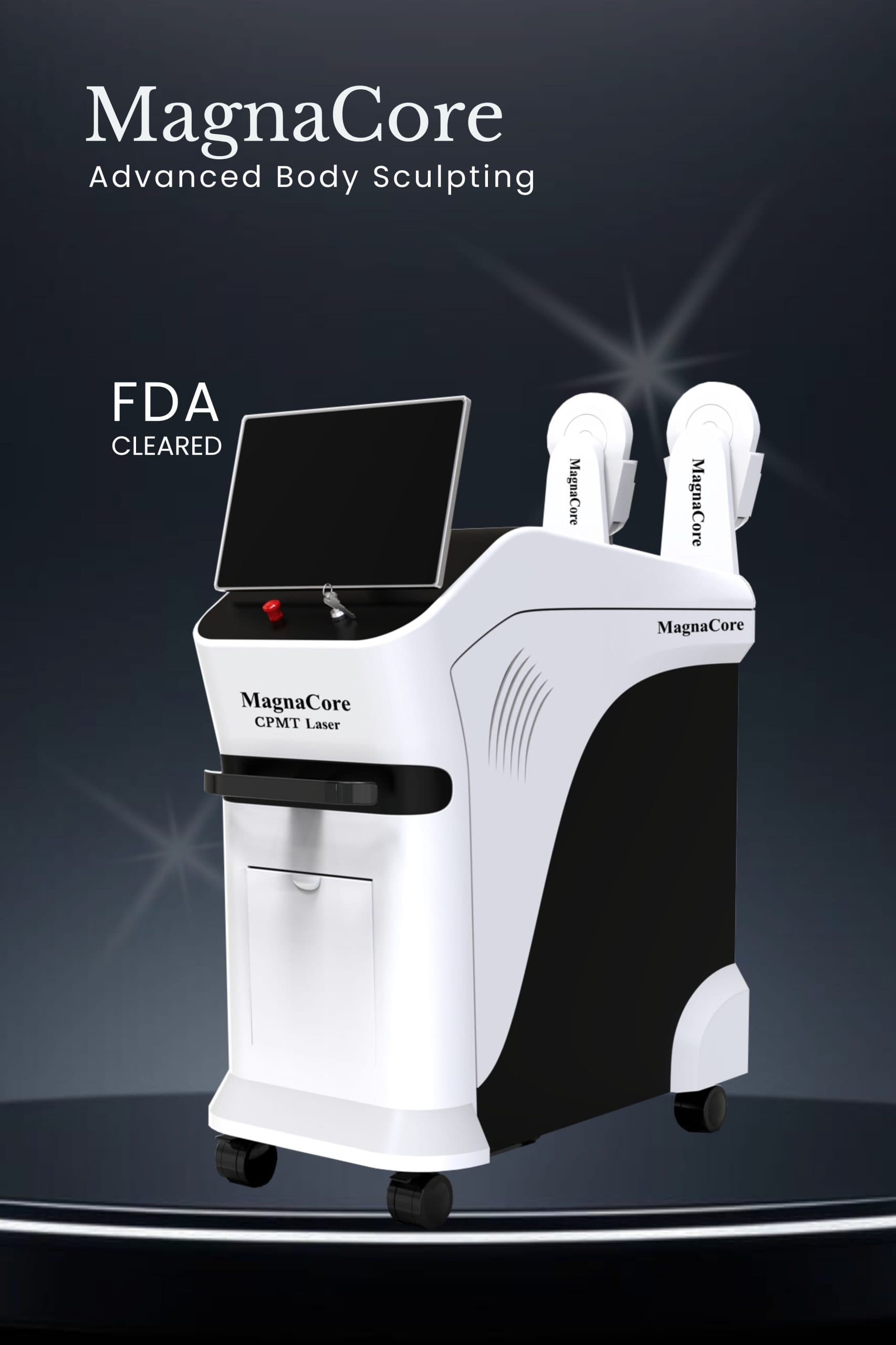
Key Benefits of MagnaCore:
- Time-efficient: Achieve results in as little as 20 minutes per session.
- Customizable: Tailor your workouts to your specific goals and fitness level.
- Non-invasive: Enjoy a painless and comfortable experience.
- Visible results: See noticeable improvements in body composition and muscle tone.
MagnaCore Specifications:
- Dual rear probes: For comprehensive muscle activation.
- Large surface area: Covers a wider range of muscles.
- Deep muscle penetration: Targets fibers up to 7 cm.
- Adjustable intensity and duration: Customize your workouts for optimal results.
- Pre-programmed protocols: Simplify your training routine.
- User-friendly interface: Easily navigate and control your device.
How MagnaCore Works – Science Behind EMS Body Sculpting
MagnaCore is a next-generation Electro-Magnetic Stimulation (EMS) device that builds muscle and reduces fat through high-intensity stimulation. Using powerful electromagnetic fields, it penetrates through skin and fat layers to directly activate muscle tissue, creating results far beyond what voluntary exercise can achieve.
- Technology: In a single 30-minute session, MagnaCore induces more than 20,000 supramaximal contractions in the targeted muscles.
- Mechanism: These contractions stimulate muscle growth (hypertrophy), activate satellite cells for repair and strengthening, and trigger fat metabolism through increased energy demand.
- Effects: Clinical studies show an average 15–20% muscle gain and 15–19% fat reduction in the treated area after just 4–6 sessions.
- Results: Patients often notice firmer, more toned muscles within 2–3 weeks, with peak outcomes achieved by 8–12 weeks.

Muscle response to MagnaCore frequency
- 1–10 Hz → Individual twitches (you feel small separate pulses, used in rehab/pain modulation).
- 10–20 Hz → Twitches start to overlap (partially fused contractions).
- 20–30 Hz → Tetany begins (muscle fibers don’t relax fully between pulses → smoother, stronger contraction).
- 50–150 Hz → Complete, sustained contraction (continuous tetany). This is what MagnaCore uses for supramaximal contractions.

Histology (Tissue-Level Effects)
1-Skeletal Muscle Fibers (Histology):
- Skeletal muscles are made of long cylindrical multinucleated fibers.
- Within each fiber, myofibrils contain repeating units (sarcomeres) made of actin & myosin filaments.
- EMS stimulates these fibers beyond voluntary contraction capacity.
2-What happens under MagnaCore EMS:
- Muscle fibers undergo hypertrophy (increase in size) due to greater protein synthesis.
- Satellite cells (muscle stem cells) are activated, fusing with existing fibers → more nuclei → enhanced growth capacity.
- Over time, increased myofibrillar density is observed (more contractile proteins, thicker fibers).
Physiology (Functional Responses)
1-Normal Muscle Contraction:
- In voluntary exercise, the central nervous system fires motor neurons to activate motor units.
- Only a fraction of fibers are recruited at any given time (to prevent fatigue).
2-MagnaCore EMS Contraction:
- Uses electromagnetic fields to induce electrical currents in motor neurons directly inside the muscle.
- This causes all motor units in the treatment area to contract simultaneously — something the body cannot achieve voluntarily.
- These are called supramaximal contractions (20,000+ in a 30-minute session).
3-Physiological outcomes:
- Metabolic stress: Increases glucose and fatty acid consumption
- Mechanical stress: Stimulates protein synthesis → hypertrophy.
- Hormonal response: Elevates growth factors (IGF-1, VEGF) → tissue repair and angiogenesis.
Mechanism of Action
1. Electromagnetic Field Penetration
- The device generates a rapidly changing magnetic field.
- This penetrates through skin & fat (low resistance) into the muscle layer.
2. Nerve Depolarization
- Induced currents depolarize intramuscular motor neurons.
- Unlike voluntary exercise, the EMS bypasses the brain and directly excites nerves.
3. Supramaximal Contractions
- Muscles contract to their absolute maximum capacity, sustained repeatedly.
- These contractions recruit nearly 100% of motor units, compared to ~30–40% during typical exercise.
4. Muscle Remodeling
- Hypertrophy: Enlargement of existing fibers (↑ actin, myosin).
- Hyperplasia (possible): Some studies suggest new fibers may form.
- Angiogenesis: Increased capillary density improves oxygen supply.
- Mitochondrial biogenesis: More mitochondria to meet higher energy demands.
Clinical Results (What histology + physiology translate to)
- 15–20% muscle thickness increase after ~4–6 sessions.
- Improved muscle definition and strength (confirmed by MRI, ultrasound, and histological studies).
Summary
MagnaCore works by driving electromagnetic fields into muscle, causing supramaximal contractions that cannot be achieved voluntarily. Histologically, this results in muscle fiber hypertrophy and satellite cell activation. Physiologically, it boosts protein synthesis, metabolism, and vascularization. The mechanism is essentially direct neuromuscular stimulation, bypassing the CNS and forcing near-total fiber recruitment.
Skeletal Muscle Adaptation Before and After MagnaCore EMS Treatment

Differences “Before” vs “After” MagnaCore EMS
Before treatment (Normal muscle):
- Muscle fibers are smaller in diameter.
- Satellite cells (muscle stem cells) are inactive, sitting around fibers.
- Capillaries are present but relatively less dense.
- Fewer mitochondria and less metabolic activity.
After treatment (Post MagnaCore EMS):
- Muscle fibers become thicker (hypertrophy) due to increased contractile proteins (actin & myosin).
- Satellite cell fusion occurs: these stem cells merge with fibers, adding nuclei → enabling more protein synthesis.
- Capillary density increases (angiogenesis), giving muscle more blood supply and oxygen.
- More mitochondria appear, boosting energy production.
About Capillaries and Location
Capillaries are not inside muscle cells — they are in the spaces between fibers (interstitial space).
- Each muscle fiber is surrounded by connective tissue (endomysium), and capillaries run along this layer.
- This allows oxygen and nutrients to diffuse into the fiber, and waste products (CO₂, lactate) to diffuse out.
- The diagram you saw simplified capillaries for clarity, but histologically they wrap around muscle fibers externally, not inside their centers.
Summary
- Before: thinner fibers, less blood supply, inactive satellite cells.
- After MagnaCore: hypertrophied fibers, satellite cell fusion, more capillaries around fibers, higher metabolic capacity.
- Capillaries are never inside fibers — they run between and around them.

When Results Appear
1. Histological (tissue-level, microscopic):
- Satellite cell activation → begins after 1–2 sessions.
- Muscle fiber hypertrophy (increase in diameter) → usually measurable in 2–4 weeks (after 4–6 sessions)
- Capillary density increase → observed after 4–6 weeks, as angiogenesis requires repeated stimulus.
2. Biological (metabolic & cellular):
- Mitochondrial activity, ATP turnover, and protein synthesis rise after the first few sessions.
- Lipolysis (fat breakdown) begins during the first treatments but noticeable reductions in fat layer thickness usually occur after 4+ sessions.
- Growth factors (IGF-1, VEGF) elevate within days to weeks of treatment.
3. Physical (visible/clinical results):
- Patients may feel stronger contractions and mild firmness after the first 1–2 sessions.
- Visible toning and contouring → typically after 4–6 sessions (about 2–3 weeks).
- Peak improvements in muscle mass and fat reduction → at 8–12 weeks, as biological and histological changes accumulate.
Summary
- Early cellular changes: within days.
- Microscopic tissue changes: within 2–4 weeks.
- Visible physical results: usually after 4–6 sessions, with full outcomes in 8–12 weeks.
Experience the Future of Fitness
Ready to take your fitness goals to the next level? MagnaCore offers a convenient and effective solution. Contact us today to schedule a free consultation and discover how this revolutionary technology can transform your body.